Brecht
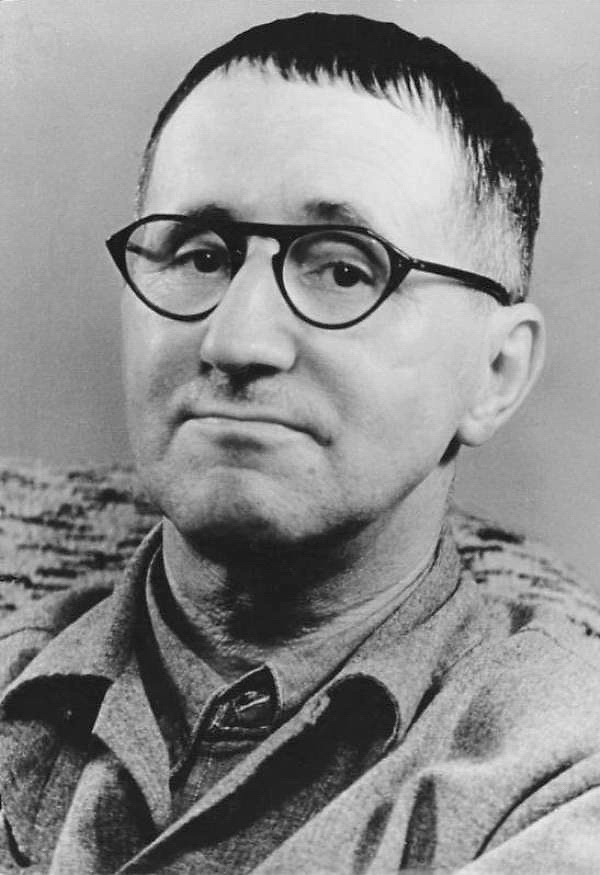 Bertolt Brecht's original name is Eugen Berthold Friedrich Brecht he was born February 10, 1898 in Augsburg, Germany and died August 14, 1956 in East Berlin, he was a German poet, playwright, and theatre director, his mother was a potistant and father a roman catholic brought up with religious views he died of a heart attack.
Until 1924 Brecht lived in Bavaria, where he was born, studied medicine (1917–21), and served in an army hospital in 1918. first play was Baar about excessive sexual pleasures.
living in Munich during the Weimar Republic, he had his first successes with theatre plays, whose themes were often influenced by his political thoughts. He was the main user of the genre named epic theatre.
During the World War II and the Nazi era he lived in exile, first in Scandinavia and then in the United States. Returning to East Berlin after the war, he then created the theatre company Berliner Ensemble with his wife, and actress Helene Weigel.
From his late twenties Brecht remained a lifelong committed Marxist (economic and social system based upon the political and economic theories of Karl Marx and Friedrich Engels) who, in developing the combined theory and practice of his "epic theatre", synthesized and extended the experiments of Erwin Piscator and Vsevolod Meyerhold to explore the theatre as a place for political ideas and the creation of a critical aesthetics of dialectical materialism.
Epic Theatre proposed that a play should not cause the spectator to identify emotionally with the characters or action before him or her, but should instead cause the audience to self-reflect and have a critical view of the action on the stage.
When naturalistic theatre was at its height and mirrored exactly what was happening in society, he decided to use it as a force for change. He wanted to make his audience think and famously said that theatre audiences at that time “hang up their brains with their hats in the cloakroom”.
In naturalistic theatre the audience care about the lives of the characters onstage. They forget the problems they are facing in their own lives and escape into the lives of others. When an audience cries for a character or feels emotion through the events happening to them it’s called catharsis, Brecht was against this type of theatre.
He believed that while the audience believed in the action onstage and became emotionally involved they lost the ability to think and to judge. He wanted his audiences to remain objective and distant from emotional involvement so that they could make considered and rational judgements about any social comment or issues in his work.


No comments:
Post a Comment